
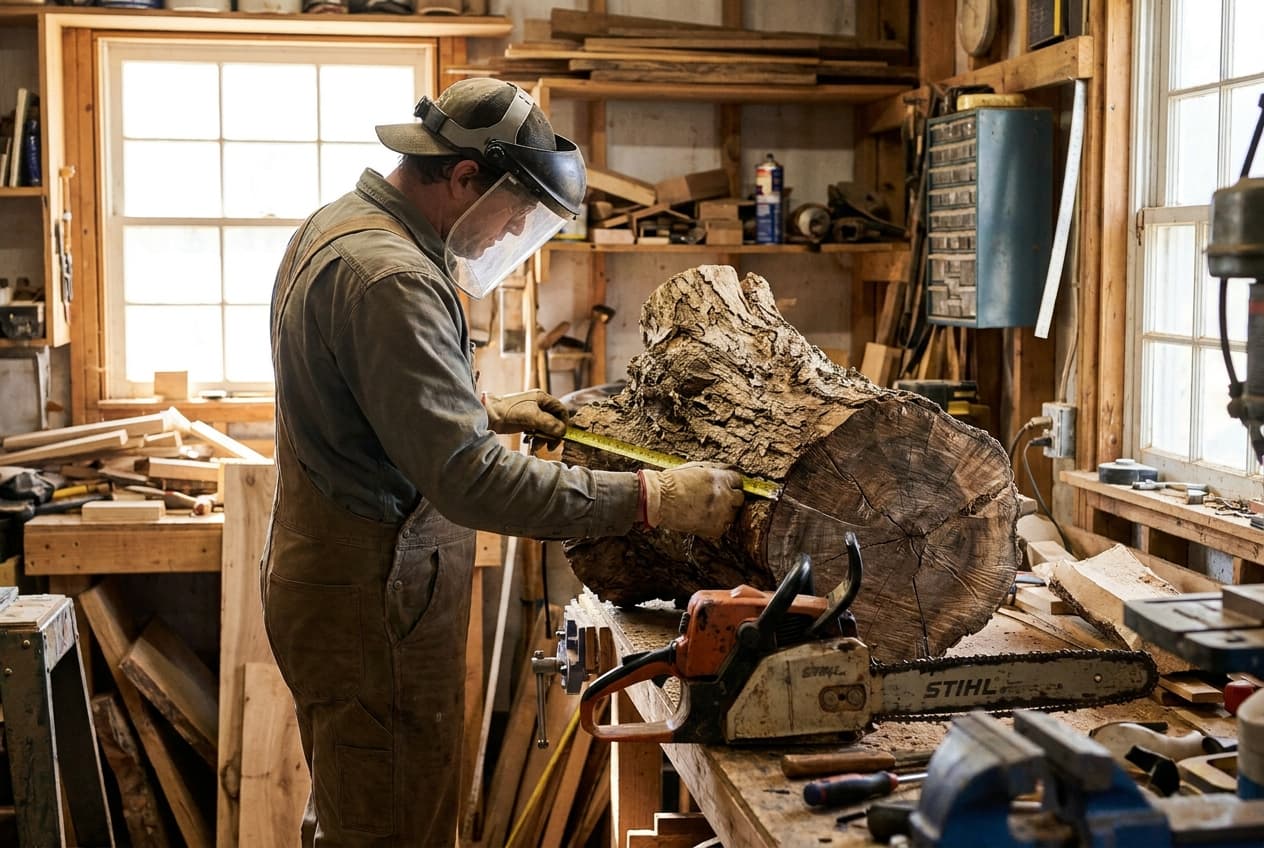
Remove a dangerous tree in Mecklenburg County turns on Charlotte’s heritage rule once the trunk is a native species at least 30 inches in diameter at 4.5 feet. The manual, CTM 1.2 dated 23 Apr 2024, says removal of any heritage tree without a permit or a city-approved land-development plan is prohibited, except for declining health or hazard.[1]
- City limits: heritage protection applies on public and private parcels whether or not you are developing.
- Imminent hazard: cut if you must, then document within three days.
- Non-development mitigation, when it is not a hazard, is $500 USD per heritage tree.
The rule on this ground
A heritage tree is a species native to North Carolina in the USDA-NRCS plants database, with DBH at least 30 inches, measured at 4.5 feet. All ash species (Fraxinus) are exempt. City trees and alley trees are not heritage trees. Inside city limits the rule applies at all times. In the extraterritorial jurisdiction it applies when land-development permitting is underway.[1] Council adopted the ordinance text behind that manual on 15 May 2023. Trees that are sufficiently diseased, injured, dead, or in danger of falling are not required to obtain a tree-work permit or to mitigate before removal, but they still have to be certified by an ISA-certified arborist or documented with pictures, video, or other records.[2]
Mecklenburg County’s own GIS office, reading a different boundary, reported 48.42% canopy inside the county line in 2023 and 50.24% inside the sphere of influence, down about 1.70 percentage points from 2012 on that sphere.[4] Those percentages explain why a 30-inch native tree is common enough to regulate. They do not, by themselves, authorize a cut. The manual does.
Declining health is stricter than a hunch. Before the saw, Urban Forestry wants the current ISA Tree Risk Assessment Form from an ISA-certified, TRAQ-qualified arborist, plus photos or analysis if needed. The form has to say entire-tree failure may occur within one to three years at a high or extreme rating. If the city agrees, there is no permit fee, no permit, and no mitigation. A true hazard is faster: failure started or is most likely within minutes, days, or under two weeks. Remove it, then file within three days. Miss the file and the manual says the owner and others may face permit fees, mitigation, civil penalties, and fines.[1]
If you skip it
Cutting a heritage tree with no permit and no hazard file is the violation the manual leads with. The mitigation payment, when the removal is not a hazard, is $1,500 per tree on a development and $500 per tree when you are not in land development. Planting past the minimum mitigation trees can reduce that payment by $250 each. A non-development heritage permit, when you do need one, expires after one year. The manual does not publish how many business days the review takes, so this page does not invent a turnaround.
Who signs, who pays, how long
| Step | Who | Published timing or fee |
|---|---|---|
| Imminent hazard | Owner or contractor files after the cut | Within 3 days. No permit before the cut. No mitigation if it qualifies. |
| Declining health | ISA-certified, TRAQ-qualified arborist, then Urban Forestry | Form before work. Failure in 1–3 years at high or extreme. No permit fee if accepted. |
| Ordinary non-development removal | Owner applies for a non-development heritage tree permit | Permit valid 1 year. Mitigation $500 per tree. |
| Development removal | Land-development plans | Mitigation $1,500 per tree, less $250 for each extra mitigation tree. |
Why the next county is a different URL
| Question | Charlotte | Raleigh |
|---|---|---|
| Size that starts the rule | 30 inches DBH, native species | Hazard test can start at 10 inches DBH, or an 8-inch limb |
| Species carve-out | All ash exempt from heritage status | Not an ash exemption. The test is defect, size, failure potential, and a target. |
| After a sudden failure | Three-day documentation clock | Unsafe trees can be a minor removal for one year after a declared ice storm, hurricane, or tornado |
The neighboring note is Triangle hazardous trees. If the next town still read true under Charlotte’s 30-inch line, this page would not exist.
Checklist for this trunk
- Confirm the parcel is inside Charlotte city limits or only in the ETJ at the moment of a development permit.
- Measure at 4.5 feet. Under 30 inches, this heritage payment schedule is the wrong schedule.
- Identify the species. Ash is exempt. A willow oak is not.
- Decide hazard versus declining health before anyone climbs. The TRAQ form is before the cut only on the slower track.
- Keep photos of the crack, the target, and the stump diameter. The three-day file is useless without them.
Fee and timeline the document actually prints
Use the table above. Do not add a crane day-rate. The manual prints $500 and $1,500, the $250 reduction, the one-year permit, and the three-day hazard file. It does not print a price for the climber. Critical root zone protection, when you are keeping the tree, is one linear foot of protection per inch of DBH. That radius matters if the “removal” is really excavation under a tree you claimed to save.
Questions people type before they hire
Is every big oak in Mecklenburg a heritage tree?
No. The Charlotte Tree Manual limits heritage status to North Carolina native species at least 30 inches DBH, measured at 4.5 feet. All ash species are exempt. City trees and trees in alleyways are not heritage trees. In the extraterritorial jurisdiction the preservation rules apply at land-development permitting, not to every non-development yard the way they do inside city limits.
Can I cut a splitting tree today?
If failure has started or is most likely within minutes, days, or under two weeks, the manual allows removal without a permit first. Within three days you still send an ISA-certified arborist assessment or a combination of pictures, video, and a witness statement. A slower decline, expected failure in one to three years at a high or extreme risk rating, needs the TRAQ form before the work.
What does mitigation cost if it is not a hazard?
The 23 Apr 2024 manual lists $1,500 per heritage tree in development scenarios and $500 per heritage tree in non-land-development scenarios. Each extra mitigation tree beyond the minimum can reduce the payment by $250. Hazardous removals are not charged that mitigation. These are city payments, not the crew’s price to dismantle the tree.
Does the same 30-inch rule apply in Raleigh?
No. Raleigh’s hazardous-tree definition is a four-part test that starts at a 10-inch trunk or an 8-inch limb, and it names a target. Using Charlotte’s 30-inch heritage line on a Wake County lot is how a file gets rejected. That difference is why the Triangle page exists.
Related: Counties and Triangle hazardous trees.
References
- City of Charlotte. “Charlotte Tree Manual, CTM 1.2,” 23 Apr 2024. Heritage definition, ash exemption, hazard and declining-health tracks, mitigation payments. Accessed 12 Oct 2026. charlottenc.gov.
- City of Charlotte. Tree ordinance adopted by City Council 15 May 2023, heritage trees diseased, injured, dead, or in danger of falling. Accessed 12 Oct 2026. charlottenc.gov ordinance.
- TreesCharlotte. “Charlotte, NC Tree Canopy Assessment,” 2022 land-area canopy 47.3% in the city and 51.8% in the county, water excluded. Accessed 12 Oct 2026. treescharlotte.org.
- Mecklenburg County Geospatial Information Services. “Tree Canopy Analysis,” 2023 county-boundary canopy 48.42% and sphere-of-influence canopy 50.24%. Accessed 12 Oct 2026. gis.mecknc.gov.