
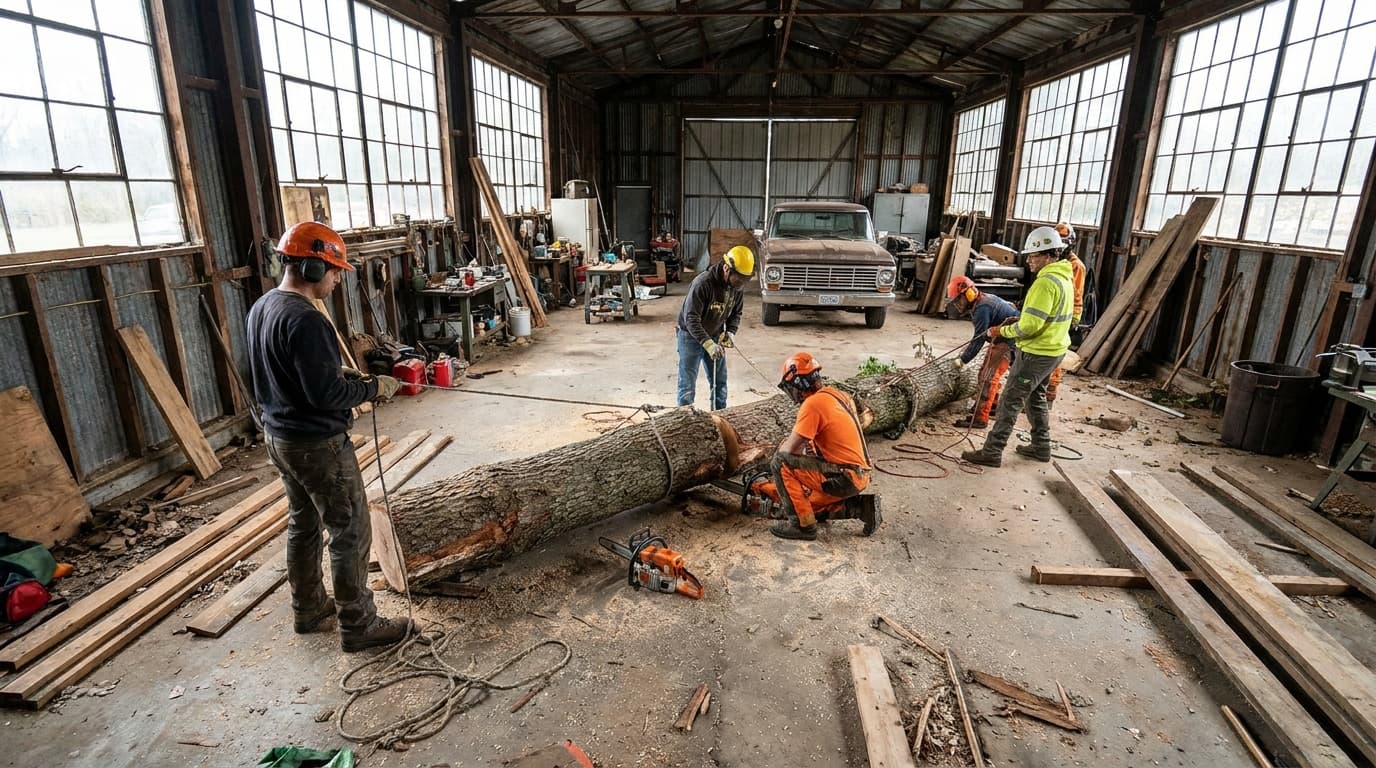
Remove a dangerous tree on a Buncombe County steep slope is narrower than a crane ticket. Ordinance text for the steep slope and high elevation overlay lets dead or diseased specimens come out of the area outside an approved disturbance. Healthy trees greater than 3 inches DBH are prohibited except when passive recreation is being installed. Vegetation removed under that exception is limited to hand-held devices.[1]
- County overlay: 2,500 feet and a natural slope of 35 percent or more.
- DBH is measured at 4.0 feet on the uphill side. Charlotte’s 4.5-foot tape is the wrong tape.
- Asheville Zone B starts lower, at 2,350 feet and 15 percent, and it regulates pruning as well as removal.
The rule on this ground
Section 78-581 defines diameter at breast height, for this article, as the outside-bark diameter at 4.0 feet above the ground on the uphill side. Section 78-584 then lists what may happen outside the disturbance shown on an approved site plan: fire-fuel reduction, listed invasive species, removal of dead or diseased specimens, maintenance of screening, maintenance for public health and safety, and non-motorized passive recreation. For the first five of those, the tool is a chainsaw, a pole pruner, a hedge trimmer, or a similar hand-held device. Bulk herbicides are prohibited. Ground cover stays, either as vegetation or as a cover that keeps sediment from leaving the site. Healthy trees over 3 inches DBH do not come out except for the passive-recreation installation.[1]
The county’s current checklist states the map test in plain language: land higher than 2,500 feet with a natural slope of 35 percent or more. When the downhill face of a structure drops 25 vertical feet or more within 100 horizontal feet, a screening plan is required. One existing or new tree credit is required for every 200 square feet of planar surface, within 50 feet of the downhill side. No single species may be more than half the planting, and the trees are spaced 10 to 30 feet apart. Saved trees have to be flagged to count. The checklist does not print a fee for cutting a dead tree.[2]
Tree removal can destabilize a slope, increase runoff and may lead to a potential landslide.
Inside the city the contours change. The 5 Apr 2018 notice, updated 3 Mar 2021, puts Zone B at or above 2,350 feet with an average slope of 15 percent or greater, and it regulates pruning as well as removal. The file wants a site plan, pictures, an explanation, and the count and type. Zone A, 2,220 to 2,349 feet, does not require a removal permit, though a root ball is still limited by UDO section 7-12-4. Houses below 2,220 feet, outside historic districts, do not need a removal permit. Commercial projects do, anywhere in the city.[3] Sec. 7-12-4 preserves slope trees except in approved grading or within ten feet of a footprint. An alternative plan goes to the tree commission. The news page describes a diameter-based fine and does not print the schedule, so neither do we.[4]
If you skip it
Taking a healthy tree over 3 inches off the county overlay, outside the passive-recreation exception, is the prohibition in the ordinance. Using a machine where the text says hand-held is the same problem. Stripping the ground cover is called out because the point of the overlay is sediment and slope, which is also the point of Hurley’s comment. Inside Asheville, skipping Zone B’s permit is the violation the city describes as an immediate fine plus replacement. The dollar table for that fine is not on the page. Henderson County’s equivalent section was not in the documents used for this note. Do not borrow Buncombe’s 3-inch line and call it Henderson law.
A dead hemlock against the eaves, above 2,500 feet on a 40 percent grade, can come out with a chainsaw if the ground cover stays. The same text does not authorize a crane pad for a healthy oak beside it. Move that cabin into Asheville at 2,400 feet and 20 percent, and Zone B wants a permit for the pruning too. The county’s 35 percent test would have missed that lot.
Who signs, who pays, how long
| Place | Who decides | Published fee |
|---|---|---|
| County overlay, dead or diseased | The ordinance exception. Planning reviews disturbance on a site plan. | No removal fee printed in the ordinance text or the checklist we read. |
| County, healthy tree over 3 inches | Prohibited except passive recreation | Not a fee. A prohibition. |
| Asheville Zone B | Permit center: site plan, photos, species, count | Fine described as diameter-based. Schedule not printed on the city news page. |
| Asheville alternative landscape plan | Tree commission | No fee printed in Sec. 7-12-4 as retrieved. |
Why Charlotte’s tape does not work here
| Measurement | Buncombe overlay | Charlotte heritage |
|---|---|---|
| Where you put the tape | 4.0 feet on the uphill side | 4.5 feet |
| Size that matters | Healthy trees over 3 inches stay | Native trees at 30 inches become heritage trees |
| Tool | Hand-held devices for the listed exceptions | No hand-tool limit in the hazard section |
The neighbor note is Mecklenburg heritage trees. Swap the slope for a Mecklenburg subdivision and the 3-inch hand-tool sentence is false.
Checklist for this query
- Read the elevation and the slope before you price a crane. County overlay and city Zone B are different contours.
- If the tree is dead or diseased on the county overlay, plan hand-held tools and leave the ground cover.
- Do not take a healthy tree over 3 inches unless the work is an approved passive-recreation installation.
- Inside Asheville Zone B, file the site plan, photos, and species list before pruning or removal.
- If you are in Henderson County, get that county’s text. It is not copied onto this page.
Fee or timeline the document prints
Neither the Buncombe ordinance excerpt nor the checklist prints a removal fee or a review deadline. Asheville describes an immediate diameter-based fine and replacement, without the table. The timeline you can use is the contour: know whether you are above 2,500 feet at 35 percent, or inside the city’s 2,350-foot Zone B, before the saw comes out. Crew day-rates are not in either document.
Questions people type before they hire
Can I take a dead hemlock off a Buncombe steep slope?
The zoning ordinance allows removal of dead or diseased specimens outside the approved disturbance area. The tool limit is hand-held: chainsaws, pole pruners, and similar. Bulk herbicides are prohibited, and ground cover has to stay. A healthy tree over 3 inches DBH is prohibited except when you are installing passive recreation. DBH on this overlay is measured at 4.0 feet on the uphill side, not at 4.5 feet.
What elevation puts me in the county overlay?
Buncombe’s steep slope and high elevation overlay applies at 2,500 feet and higher where the natural slope is 35 percent or greater. The county checklist also requires a screening plan when the downhill face drops 25 vertical feet within 100 horizontal feet: one tree credit per 200 square feet of planar surface, trees within 50 feet of the downhill side, and no single species over half the planting.
I am inside Asheville. Is the county overlay the permit?
No. The city says tree removal and pruning are regulated in Steep Slope Zone B: at or above the 2,350-foot contour with an average natural slope of 15 percent or greater. Zone A, between 2,220 and 2,349 feet, does not require a removal permit, but grading out a root ball is still limited. Single-family and two-family homes below 2,220 feet, outside historic districts, are not required to permit a removal. Commercial projects need at least a zoning expedite permit anywhere in the city.
Does Henderson County use this 3-inch rule?
Not in the documents this page cites. The URL exists because Buncombe’s hand-tool exception and Asheville’s Zone B permit are already different from each other, and both are different from Charlotte’s 30-inch heritage rule. Henderson’s text was not in the packet. Do not assume it.
Related: Counties and Mecklenburg heritage trees.
References
- Buncombe County. Ordinance amending Chapter 78, including Sec. 78-581 (DBH at 4.0 feet on the uphill side) and Sec. 78-584 (dead or diseased specimens, hand-held tools, healthy trees over 3 inches). Accessed 12 Oct 2026. ordinance PDF.
- Buncombe County Planning. “Protected Ridge & Steep Slope Overlays” checklist. 2,500 feet, 35 percent, and the planar-surface screening math. Accessed 12 Oct 2026. county checklist.
- City of Asheville. “Asheville rules regulate tree pruning and removal,” posted 5 Apr 2018, updated 3 Mar 2021. Zone A and Zone B contours. Accessed 12 Oct 2026. ashevillenc.gov.
- City of Asheville. “UDO Sec. 7-12-4, Steep slope and ridgetop development,” preservation and the tree-commission alternative landscape plan. Accessed 12 Oct 2026. Sec. 7-12-4.